
What is an AI agent knowledge base
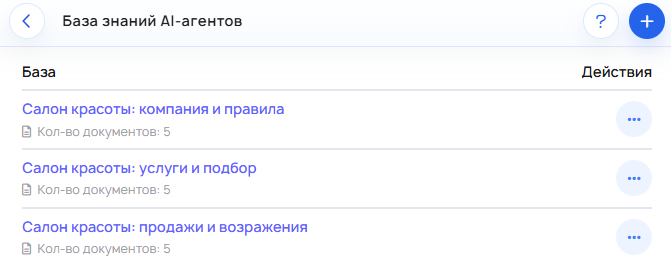
A knowledge base is where materials are stored that an AI agent uses to answer customers. You can add rules, terms, service descriptions, prices, and answers to common questions. It is not just a collection of texts, but the main source of facts for the AI agent's responses.
If you want the AI agent to answer based on your materials rather than in general terms, it needs a knowledge base.
When a knowledge base is especially needed
A knowledge base is especially important if the AI agent must:
- answer according to your business rules;
- explain terms, prices, and limitations;
- confidently answer repeated questions;
- provide more accurate and predictable responses.
You can do without a knowledge base only at a very simple launch, when the AI agent is needed for short answers, greetings, or basic navigation. But even then, the limit of quality is reached quickly.
What is included in a knowledge base
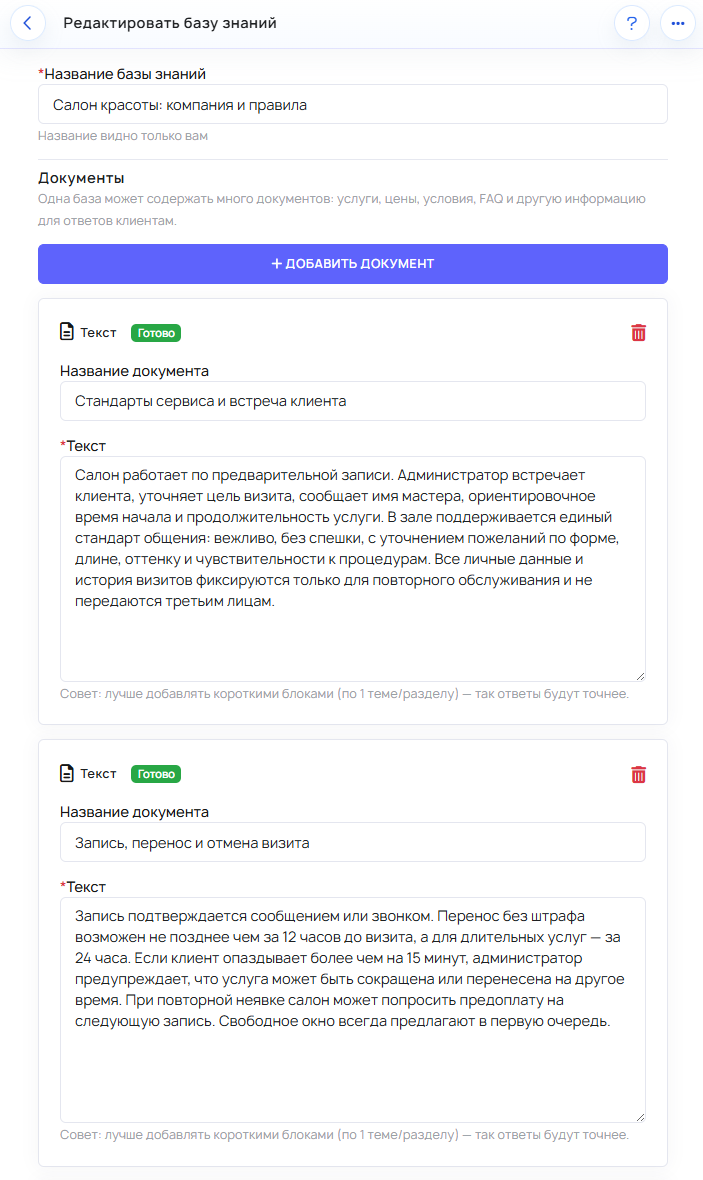
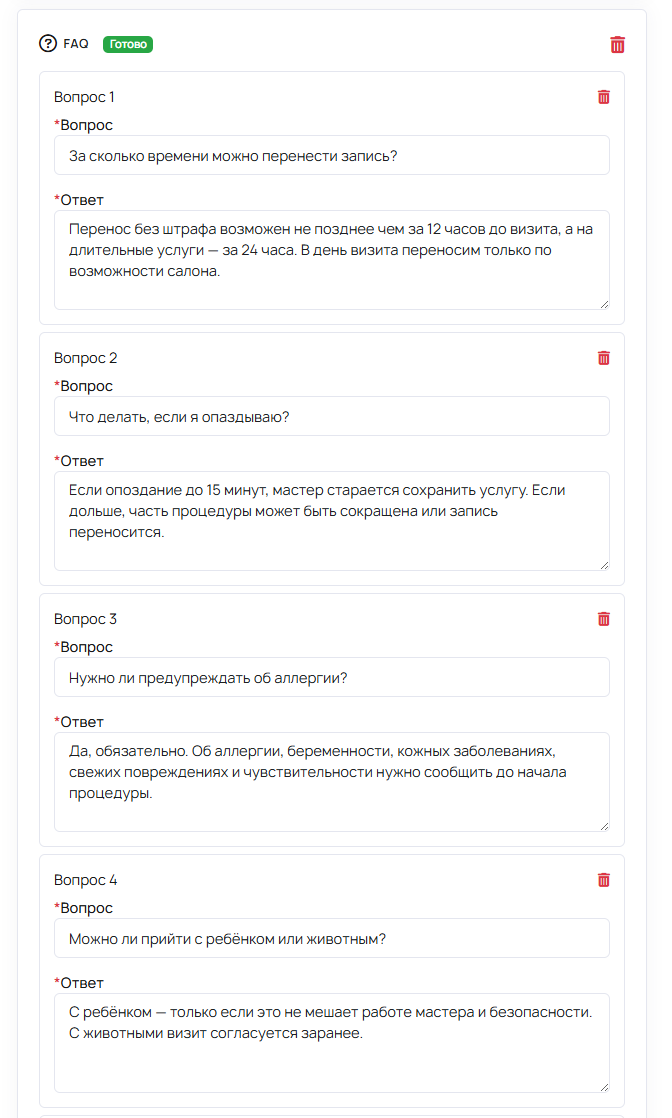
Currently, two main formats can be used in a knowledge base:
- Text — for rules, terms, service descriptions, instructions, price lists, and other detailed materials.
- FAQ — for common questions that require a short and precise answer.
A knowledge base is not one long text "about everything," but a set of clear and useful materials.
How a knowledge base works
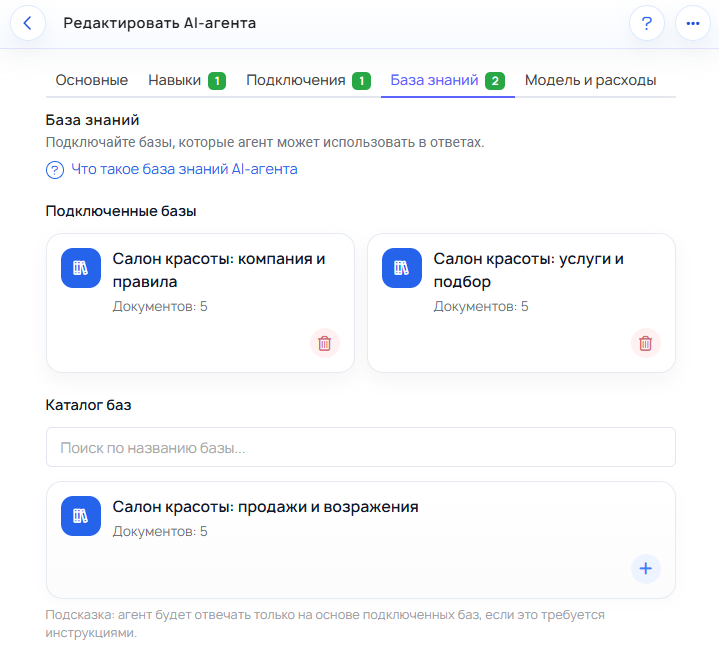
A knowledge base is created separately and then connected separately to the AI agent. The agent searches for answers only in the knowledge bases connected to it.
Keep in mind:
- it is not enough just to create a knowledge base;
- it must be connected to the right AI agent;
- if the knowledge base is not connected, the AI agent will not use it in responses.
What a knowledge base does not replace
- Instructions — they tell the AI agent how to respond.
- Knowledge base — it provides what exactly to answer.
- Skills — they are needed for actions: for example, for bookings, requests, or working with products.
- Website or channel — this is where the AI agent works, but it is not a substitute for a prepared knowledge base.
In short: instructions — how to answer, knowledge base — what to answer, skills — what to do, website or channel — where the AI agent works.
What changes after connecting a knowledge base
After connecting a knowledge base, the AI agent can:
- look for answers in your materials;
- use FAQs;
- answer more accurately about terms, services, and rules;
- rely less on overly generic wording.
As a result, responses become more useful, more consistent, and closer to the real rules of your business.
When quality quickly hits a ceiling without a knowledge base
This happens especially quickly if:
- you have many conditions and exceptions;
- customers ask the same questions often;
- the AI agent must answer about prices, timelines, services, and rules;
- you need accurate and predictable answers.
In such cases, it is harder for the AI agent to provide stable answers without a knowledge base.
What is important not to confuse
Most often, users make mistakes in three areas:
- they think everything can be written in the instructions and that will be enough;
- they believe the knowledge base will replace skills on its own;
- they forget to connect the created knowledge base to the AI agent itself.
It is better to treat the knowledge base as a separate and important part of AI agent setup, not as a secondary element.